title. Coming Full Circle: Teaching Lifesaving Skills at My Alma Mater
date. 3.13.2026
author. Damon Gorelick (damongorelick@demca.org)
Damon Gorelick is the Executive Director at the Detroit East Medical Control Authority and a graduate of Wayne State University who earned his BA in Psychology.
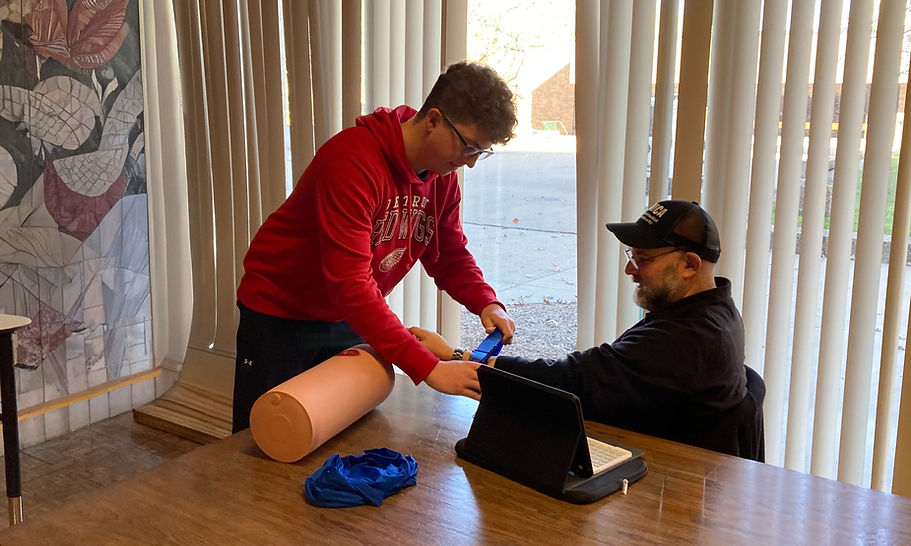
Over the past several years, I’ve been part of a project that gave me the chance to share one of the most practical skills anyone can learn: how to stop a life-threatening bleed. The project took place at Wayne State University, where students enrolled in a communication course were taught Stop the Bleed at the beginning of the semester and then re-tested at the end of the term. The goal was to see how much students would remember over time, but for me, it was also about being in the classroom with them and seeing how they responded to the training.
What Is Stop the Bleed?
Stop the Bleed is a program that shows people how to respond if they come across someone with a life-threatening bleed. It teaches people three basic steps: how to apply direct pressure, how to use a tourniquet if one is available, and how to pack a wound. The point is simple—emergencies can happen anytime, anywhere, and people nearby may be able to make a lifesaving difference before an ambulance arrives.
Bringing this training into a communication course felt important because college students were learning to connect with others, to craft effective messages, and persuade others’ behavior. Many hadn’t thought about what they would do in a trauma situation. This training gave them practical skills they could use if the moment ever came.
How did the students respond?
What I liked most was how the students thought through the training scenarios. They didn’t just follow steps—they asked questions that showed they were imagining themselves in a real situation. Some questions were practical: “What if I don’t have a tourniquet?” Others were about how they might react: “What if I freeze up?” Those conversations made the training feel less like a checklist and more like something they could actually do in the future. Usually, I see people one time, just for a single training session; but in this project, I came back at the end of the semester to re-test students’ skills. Being able to examine bleed control retention as a Stop the Bleed instructor was insightful.
Returning to Campus
As an alum, this project allowed me to go back to Wayne State. When I returned to campus I noticed all the changes at once—new buildings, updated spaces, and different groups of students. It reminded me of my own time there, and showed how the campus keeps moving forward.
Standing in the classroom felt like coming full circle. Years ago, I was in those seats as an undergraduate student. Now I was on the other side, sharing something I hoped these students would carry with them beyond college.
Why This Matters
Looking back on the project, the main takeaway is that lifesaving skills don’t have to be complicated. Stop the Bleed shows that with a short, hands-on session, people can be ready to act in an emergency. Over the years, many students in these communication courses have gone through the Stop the Bleed program. Some may never need the skills, but they now know they have them. More than that, they know they can step forward in an emergency instead of standing by. That willingness to act might be the most important thing they take away.